




Is Retainer Cleaner HSA Eligible?
If you pay for a retainer cleaner with HSA or FSA funds, the potential savings are real — but whether a specific product qualifies depends on factors most guides skip entirely. This article explains how IRS rules apply to retainer care products, what questions to ask your benefits administrator, and how to make an informed decision before you buy.
The IRS Rule That Makes This Possible
The foundation for HSA and FSA eligibility is IRS Section 213(d), which defines qualified medical expenses as costs related to the "diagnosis, cure, mitigation, treatment, or prevention of disease." Dental appliances — including orthodontic retainers, clear aligners, dentures, and night guards — are prescribed medical devices. Products used to maintain them occupy a grey area that many plan administrators interpret as eligible, but individual plans vary.
The CARES Act of 2020 also expanded the list of eligible OTC items without requiring a prescription or Letter of Medical Necessity — which is why many dental hygiene products for prescribed appliances now fall within scope. However, CARES Act eligibility still requires that the product and the retailer meet certain conditions, which brings us to the most important part of this guide.
Which Account Types Could Cover Retainer Cleaners?
| Account Type | Potentially Eligible? | Key Notes |
|---|---|---|
| HSA (Health Savings Account) | ⚠️ Possibly | Requires HDHP enrollment; funds roll over indefinitely; confirm with administrator |
| FSA (Healthcare FSA) | ⚠️ Possibly | Use-it-or-lose-it each plan year; confirm eligibility before deadline |
| HRA (Health Reimbursement Account) | ⚠️ Possibly | Employer-funded; coverage terms vary significantly by plan |
| LPFSA (Limited Purpose FSA) | ⚠️ Possibly | Dental-focused; dental appliance care products are within scope in many plans |
| DCFSA (Dependent Care FSA) | ❌ No | Covers childcare and dependent expenses only — not medical or dental products |
Why "IRS Eligible" and "Your Card Works at Checkout" Are Two Different Things
This is the part most HSA/FSA guides fail to explain — and it causes the most confusion.
The IRS defines broad categories of eligible expenses. But when you swipe your HSA or FSA debit card at a store, a separate system called IIAS (Inventory Information Approval System) decides in real time whether to approve the transaction. IIAS works by matching the product's barcode against a database of pre-approved items. If a product isn't in that database — even if it's theoretically IRS-eligible — your card will be declined at checkout.
This is why two products that both qualify under IRS rules can behave very differently at the register: one is in the IIAS system and processes automatically; the other isn't, and requires manual reimbursement.
Which Types of Retainer Cleaners Are Most Likely to Qualify?
The IRS framework suggests that products used to care for prescribed dental appliances fall within the dental expense category. Here is how common retainer cleaning product types are generally interpreted — though again, your specific plan has the final word:
| Product Type | General IRS Interpretation | Practical Consideration |
|---|---|---|
| Ultrasonic retainer cleaning machines | ⚠️ Potentially eligible as dental care device | Higher-value purchase; manual reimbursement claim more likely needed; plan-dependent |
| Cleaning tablets / effervescent pods | ⚠️ Potentially eligible as dental cleaning supply | Widely available at IIAS retailers; auto-approval more likely for branded products |
| Retainer cleaning sprays / solutions | ⚠️ Potentially eligible | Verify product is specifically for dental appliances, not general use |
| Multi-use ultrasonic cleaners (dental + jewelry) | ⚠️ Grey area | Dual-purpose devices face more scrutiny; a dental-specific device is a stronger claim |
What Dental Products Are Clearly NOT Eligible
The core distinction the IRS draws is between products that maintain a prescribed dental appliance (potentially eligible) and general oral hygiene products for natural teeth (not eligible). Understanding this line helps you avoid a rejected reimbursement claim.
| Product | Eligible? | Reason |
|---|---|---|
| Retainer cleaners (for prescribed appliances) | ⚠️ Possibly — confirm with plan | Dental appliance care; plan-dependent |
| The orthodontic retainer itself | ✅ Yes | Prescribed dental appliance — clearly eligible |
| Denture cleaners | ⚠️ Possibly — confirm with plan | Same category as retainer cleaners |
| Electric toothbrush | ❌ No | General oral hygiene — not prescribed |
| Toothpaste | ❌ No | General oral hygiene |
| Dental floss | ❌ No | General oral hygiene |
| Teeth whitening kits | ❌ No | Cosmetic — not medically necessary |
| Mouthwash | ❌ No | General oral hygiene |
How to Actually Use HSA/FSA Funds for a Retainer Cleaner
If you've confirmed with your plan administrator that retainer cleaners are covered, here are the three ways to use your funds:
Option 1 — Purchase from an IIAS-Certified Retailer (Easiest)
- Shop at Amazon, Walmart, CVS, Walgreens, HSAStore.com, or FSAStore.com
- Search for the specific retainer cleaner product you want
- Look for the "FSA or HSA Eligible" badge on the product listing
- Pay with your HSA or FSA debit card — the transaction is auto-approved at checkout
Option 2 — Buy Anywhere, Then Submit a Manual Reimbursement
- Purchase the retainer cleaner using any payment method
- Save your itemized receipt — it must show the product name, date, and amount paid
- Log into your HSA or FSA administrator's portal (HealthEquity, Optum, Lively, WEX, etc.)
- Submit under "Reimbursement Request" — include receipt and a brief note that the product is for a prescribed dental appliance
- Approval typically takes 3–7 business days; some plans may request additional documentation
Option 3 — Request a Letter of Medical Necessity (If Your Plan Requires It)
- Ask your orthodontist or dentist to write a brief LMN stating that retainer maintenance products are necessary for your prescribed appliance
- Submit the LMN along with your receipt to your benefits administrator
- An LMN is not required by the CARES Act for OTC items, but some stricter plans may still ask for one — particularly for higher-cost devices
HSA vs. FSA: Planning Your Purchase
| Feature | HSA | FSA |
|---|---|---|
| Requires HDHP health plan | ✅ Yes | ❌ No |
| Funds roll over year to year | ✅ Yes, indefinitely | ❌ Generally use-it-or-lose-it |
| 2026 contribution limit | $4,400 individual / $8,750 family | $3,400 |
| Portable if you change jobs | ✅ Yes | ❌ No |
| Can invest unused funds | ✅ Yes | ❌ No |
| Best timing for retainer cleaner purchase | Any time — no deadline pressure | Before your plan year end date |
If your FSA deadline is approaching and you have a remaining balance, a retainer cleaner is among the more defensible dental-adjacent purchases you can make — provided your plan covers it. It is worth a 5-minute call to your benefits administrator to confirm before your funds expire.
How Much You Could Save If Your Plan Qualifies
If your plan administrator confirms coverage, the tax math is straightforward. HSA and FSA contributions are made with pre-tax dollars, so every eligible purchase is effectively discounted by your federal income tax rate.
| Federal Tax Bracket | Purchase Price | Effective Out-of-Pocket Cost | You Save |
|---|---|---|---|
| 12% | $89.99 | ~$79.19 | ~$10.80 |
| 22% | $89.99 | ~$70.19 | ~$19.80 |
| 24% | $89.99 | ~$68.39 | ~$21.60 |
| 32% | $89.99 | ~$61.19 | ~$28.80 |
Example based on Voraiya Oral Station ($89.99). Savings = Purchase Price × Tax Rate. Actual savings vary based on state taxes and individual circumstances.
Choosing the Right Retainer Cleaner — Independent of How You Pay
Whether or not you use HSA or FSA funds, the cleaning method you choose has a direct impact on your retainer's lifespan and your oral health. Most common cleaning approaches — soaking tablets, rinsing, brushing with toothpaste — address only the surface layer of debris. They do not remove biofilm: the structured layer of bacteria that bonds to retainer material within minutes of use and is the primary cause of persistent odor and increased periodontal risk.
Ultrasonic cleaning works through acoustic cavitation — millions of microscopic bubbles per second that physically dislodge biofilm, break down calcium deposits, and penetrate micro-scratches that no soaking solution can reach. It is a fundamentally different mechanism from chemical soaking, not just a more powerful version of the same thing.
When evaluating an ultrasonic retainer cleaner, the key specifications to look for are:
- Operating frequency of 40kHz or higher — finer cavitation bubbles mean more contact points per second across the entire surface
- Multiple cleaning modes — a short daily cycle and a longer deep-clean cycle serve different needs
- Material compatibility — confirmed safe for thermoplastic (Essix/Invisalign-style), acrylic, and metal components
- Tank depth adequate for your appliance — retainers and aligners require less depth than full dentures
For a full breakdown of why most cleaning methods fail to eliminate retainer odor and what the science says about biofilm removal, see: Why Do Retainers Smell Even After Cleaning?
Our Retainer Cleaners

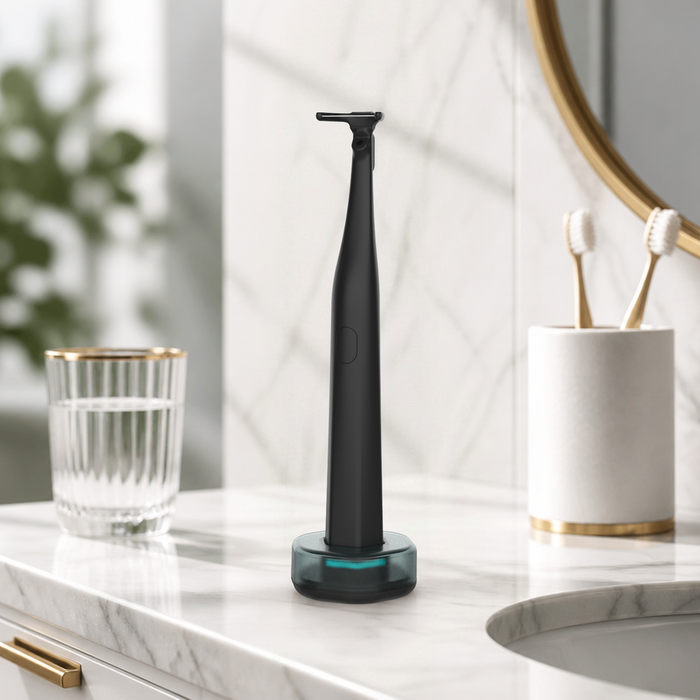
Voraiya Oral Station
- 45kHz ultrasonic frequency — high-density cavitation for thorough biofilm removal
- UV-C sterilization — eliminates 99.9% of bacteria in a single 6-minute cycle
- No chemicals required — just water; no recurring tablet costs
- Universal compatibility — retainers, aligners, dentures, night guards
- 30-day money-back guarantee + 1-year manufacturer warranty
Voraiya Oral Pod
- 45–52kHz precision frequency — fine, thorough cleaning for all appliance types
- 3 smart modes — Quick Wash (3 min), Standard (5 min), Deep Sanitization (8 min)
- 166ml compact tank — travel-ready; fits desk, nightstand, or bathroom counter
- One-touch operation — no settings to configure
- 1-year warranty included
Frequently Asked Questions
Is an ultrasonic retainer cleaner HSA or FSA eligible?
It depends on your specific plan. Under IRS Section 213(d), products used to maintain prescribed dental appliances are generally categorized as dental care expenses. However, individual plan administrators make the final determination, and IIAS certification affects whether your card will auto-approve at checkout. Confirm with your benefits administrator before purchasing.
Do I need a prescription to use my HSA on a retainer cleaner?
The CARES Act (2020) removed the prescription requirement for most OTC dental care items. In most cases, a Letter of Medical Necessity is not required — but some plan administrators may request documentation for higher-cost devices. Check your plan's specific rules.
My HSA debit card was declined when I tried to buy a retainer cleaner online. Does that mean it's not eligible?
Not necessarily. A declined card usually means the retailer is not IIAS-certified, so the system cannot auto-verify the purchase — not that the product itself is ineligible. The solution: pay with a regular card, save your receipt, and submit a manual reimbursement claim through your benefits portal. Whether it's approved depends on your plan's terms.
Can I use an expiring FSA balance to buy a retainer cleaner?
If your plan covers retainer care products, using expiring FSA funds on a retainer cleaner is a reasonable choice. Confirm eligibility with your administrator before your plan year deadline — approval is not guaranteed and varies by plan.
What's the difference between HSA and FSA for this kind of purchase?
Both work the same way for reimbursement purposes. The main practical difference: HSA funds roll over indefinitely, so there's no deadline pressure. FSA funds are typically use-it-or-lose-it at year end, which makes them more time-sensitive to spend down on eligible purchases.
Clean smarter — with or without HSA/FSA.
Voraiya Oral Station — 45kHz Ultrasonic + UV-C Sterilization.
One-time purchase. No recurring tablet costs. Deep biofilm removal in 6 minutes.
700+ Verified Reviews · 30-Day Money-Back Guarantee
Shop the Oral Station →This article is for informational purposes only and does not constitute tax or financial advice. HSA and FSA eligibility is determined by your plan administrator and may vary. Consult your benefits administrator or a qualified tax professional before making purchasing decisions based on HSA/FSA eligibility. For IRS guidelines on eligible medical expenses, refer to IRS Publication 502.

