


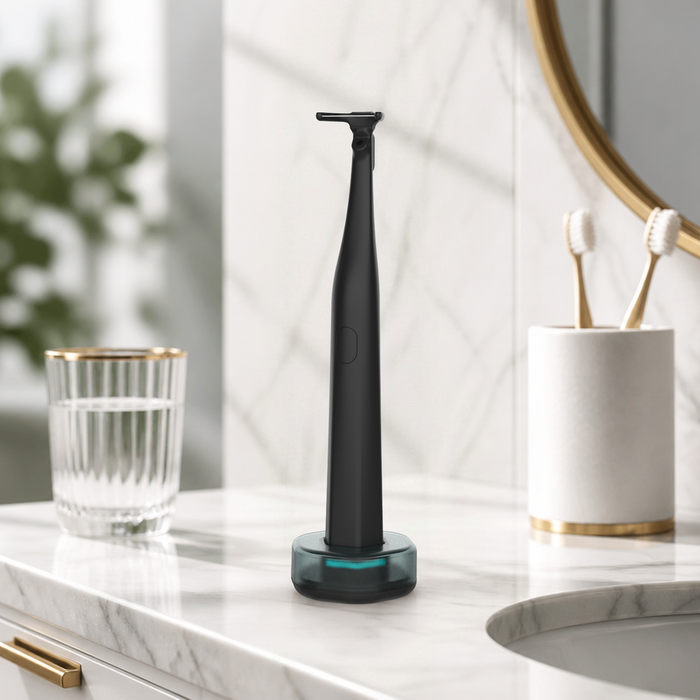


52kHz Ultrasound + UVC: The Future of Oral Appliance Cleaning
Share
For most of us, removable dental appliances—whether they are clear aligners like Invisalign®, retainers, night guards, or dentures—are a major investment in both our health and our confidence. However, there is a hidden struggle that every user faces: the persistent buildup of plaque, bacteria, and unpleasant odors. Despite our best efforts with manual brushing or chemical soaks, many oral devices never feel truly "clean."
The reason is simple but alarming: Biofilm. Bacteria don't just float in your mouth; they build microscopic fortresses on the surfaces of your dental appliances. To destroy these fortresses, a simple rinse isn't enough. You need a medical-grade synergy of physics and biology. Today, we’re diving deep into the science behind the Voraiya Oral Pod’s dual-engine technology.
Within minutes of placing an appliance in your mouth, proteins from your saliva begin to coat the surface. This creates a "scaffold" for bacteria like Streptococcus mutans and Porphyromonas gingivalis to attach and multiply. Over time, this biofilm mineralizes into tartar, which is impossible to remove without professional-grade force.
1. The Physics of 52kHz Ultrasonic Cavitation
Ultrasonic cleaning is often misunderstood as simple vibration. In reality, it is a high-energy physical event called Acoustic Cavitation. When sound waves travel through water at high frequencies, they create millions of microscopic vacuum bubbles. When these bubbles encounter a surface, they "implode" with incredible localized force.
Why Frequency Matters: Most generic household cleaners run at 40-42kHz. While this is sufficient for jewelry, it is often too "coarse" for the delicate, porous surfaces of dental thermoplastic materials. Voraiya’s engineers pushed the boundary to 52,000Hz (52kHz).
- Micro-Precision: Higher frequencies create smaller bubbles. These smaller bubbles can navigate into the microscopic pores of your aligners where lower frequencies simply cannot reach.
- Gentle yet Powerful: 52kHz provides a more "dense" cleaning effect, blasting away plaque without the physical abrasiveness that can scratch and cloud clear retainers.
2. The Biology of UVC Sterilization (260-280nm)
If ultrasound is the "muscle" that removes physical debris, UVC light is the "assassin" that targets biological pathogens. Even after the physical plaque is gone, live bacteria often remain embedded in the material. This is why many retainers still smell bad even after they look clean.
Medical-grade UVC light operates at a specific wavelength (260-280nm) that penetrates the cell walls of microorganisms. It disrupts the molecular bonds in their DNA and RNA, rendering them unable to reproduce or cause infections. A study published in the Journal of Hospital Infection confirmed that UVC light at these wavelengths can eliminate up to 99.9% of common oral pathogens within a single cleaning cycle.
3. The Revolutionary Cordless Design
Until recently, clinical-grade ultrasonic cleaners were bulky, wired machines. For a device used daily in a bathroom—a naturally wet and humid environment—wires are not just inconvenient; they are a safety risk. The Voraiya Oral Classic changed the game with a high-capacity (3000-4000mAh) rechargeable battery.
- Total Safety: No risk of electrical shock or short-circuits in the bathroom.
- Lifestyle Integration: Clean your aligners at the office after lunch, in a hotel while traveling, or on your nightstand—no searching for a wall outlet required.
The Verdict: Clinical Clean for Your Daily Routine
By combining the physical scrubbing of 52kHz cavitation with the biological protection of UVC light, the Voraiya Oral Classic offers a standard of hygiene previously only available in dental labs. It doesn't just make your retainers look clear; it makes them biologically safe for your mouth.
GET THE CLINICAL CLEAN - SHOP VORAIYA NOW1. Barnes, C.M., et al. (2014). "The evaluation of ultrasonic cleaning on the surface of dental appliances." Journal of Dentistry.
2. Hodges, S. M., et al. (2020). "UVC disinfection and its effectiveness in medical environments: A systematic review." Journal of Hospital Infection.
3. Ribeiro, L. S., et al. (2014). "Streptococcus mutans survival on dental thermoplastic materials: The role of cleaning protocols." Applied and Environmental Microbiology.


